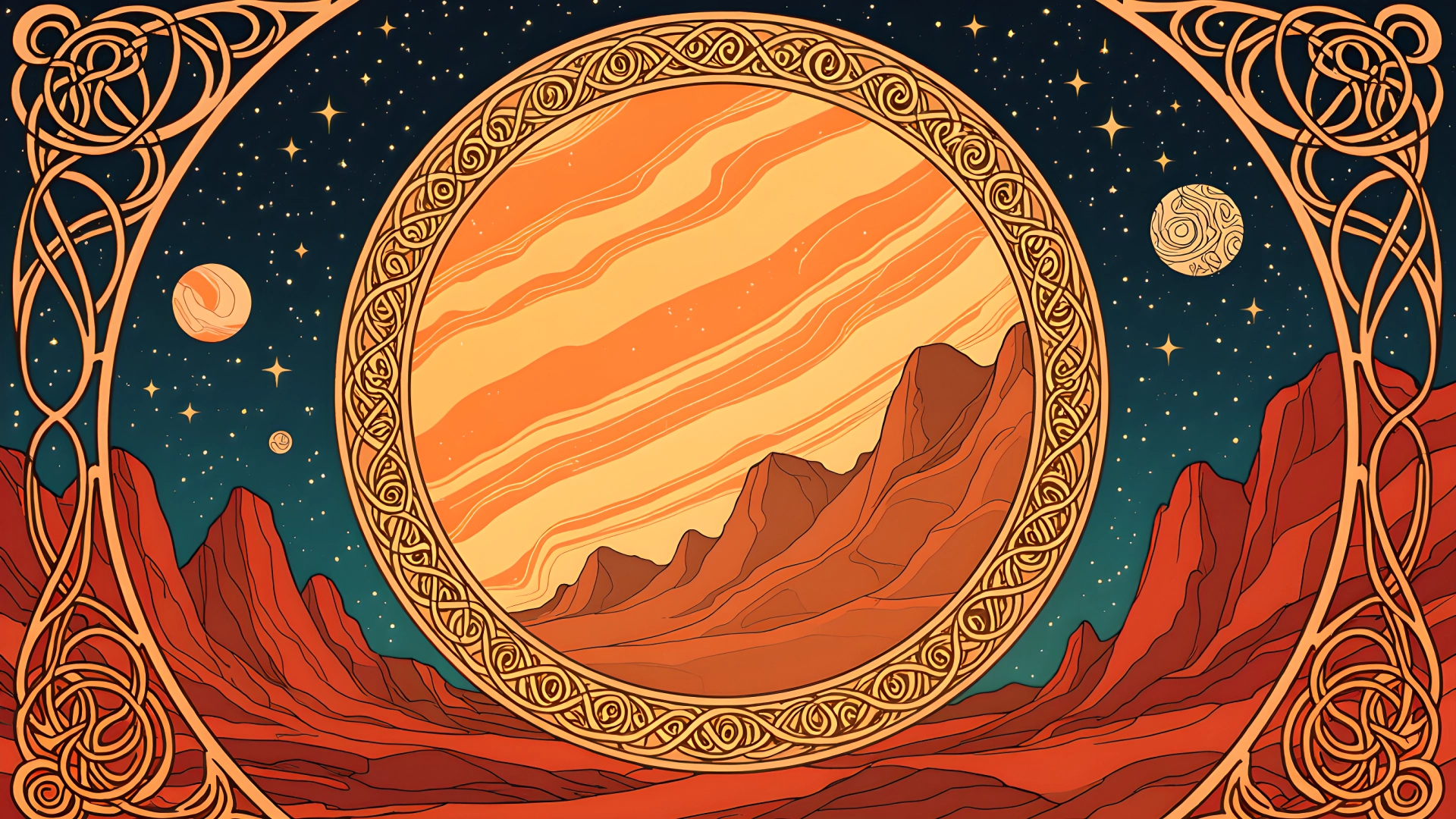
The Red Planet
From our vantage point on Earth, Mars is our smaller but strikingly familiar neighbour, a world shaped by dust storms, iron-rich terrain and the faint memory of ancient water. Where astronomy sees a planet, astrology sees a beacon of life-force, a red spark that reflects our own human impulse to act. Mars brings heat to cold plans, courage to tired hearts and the momentum that begins movement. Whenever we speak of motivation, desire, conflict or drive, we are speaking the language of Mars.
Below are the core qualities traditionally associated with this fiery influence.
• Action, willpower, drive and raw life-force
Mars is the animating spark that stirs ambition and pushes us into motion. It governs the instinct to begin, to take initiative and to convert intention into action.
• Assertion, desire, courage and confrontation
This planet shapes the way we stand our ground, pursue what matters and respond to pressure. It speaks to our boundaries, our courage and the force we bring to challenges.
• Sexual energy, attraction and instinctual desire
Mars describes the passionate and physical dimensions of wanting. It colours our urges, our magnetism and our ability to express desire directly and confidently.
• The shadow: anger, impatience and destructive heat
When misdirected, Mars can become volatile, impulsive or confrontational. Its fire needs direction; without it, tension may rise quickly and burn too hot.
⭐ General Significance of Mars
Across both myth and astrology, Mars carries a consistent thread of symbolism. It represents the moment when intention becomes action and when inner heat presses outward into movement. Mars describes how we pursue goals, how we defend our boundaries and how we respond when life demands courage. It is the planet of momentum, the force that cuts through hesitation and animates the will.
In charts and transits, Mars shows where energy rises, where pressure builds and where decisive choices are likely to appear. It highlights the instinctive side of human behaviour: the spark that initiates change, the bravery required to confront difficulty and the desire that propels us forward. Where Mars moves, life tends to become more immediate, more physical and more vividly felt.
Mars also marks periods of focus, conflict or breakthrough. Its movement through a sign or house often reveals where effort is needed, where frustration may surface and where progress becomes possible after a long plateau. Whether gentle or intense, direct or indirect, Mars brings motion to places that would otherwise remain still.
This overarching significance informs the meaning of its transits through each zodiac sign, shaping how its fire blends with different elements and qualities across the sky.
⭐ Mars in the Zodiac Signs
Mars in Aries
Mars blazing through Aries marks one of the most noticeable phases of the year. This is Mars back in command of its own territory, and life tends to speed up whether you asked for it or not. Decisions become instinctive, energy rises sharply, and the world feels more urgent, more vivid, and more combustible. People push harder, speak faster, and move first, sometimes before consequences have caught up.
Although this transit typically lasts six to seven weeks, it often feels longer because its effects are so immediate.
This can be a superb time for beginning projects, reclaiming agency, or breaking out of paralysis – especially when this occurs in your First House, where it picks up your courage, confidence, and sense of momentum.
Mars Retrograde in Aries
When retrograde here, Mars creates a strange inversion: the warrior must turn back, rethink the strategy, and reclaim old terrain instead of charging ahead. Frustration can rise sharply, especially when attempts to act meet delays, reversals, or unexpected resistance.
But this inward reversal can also be valuable, illuminating the motives behind your impulses and helping you redirect your fire toward what actually matters.
Mars in Taurus
Mars entering Taurus cools the pace but strengthens resolve. Instead of the wildfire rush of Aries, Taurus brings a slow-building, muscular determination – the kind of effort that doesn’t tire easily. Desire settles into something long-term: building security, protecting resources, or committing to tangible outcomes.
This transit lasts for no more than seven weeks, but because Taurus moves slowly and Mars digs in, it often feels like a season of consolidation.
When this movement activates your Second House, issues around spending, savings, and self-worth take on a more decisive, grounded tone.
Mars Retrograde in Taurus
A retrograde here churns up old financial patterns, value conflicts, or long-standing frustrations linked to stability. Progress slows, but awareness deepens. It’s an excellent period to reassess what is worth your energy – and what simply isn’t.
Mars in Gemini
When Mars is in Gemini, sparks scatter in every direction. Energy becomes verbal, clever, restless, and quick to adapt. You may feel pulled into multiple threads at once – conversations, small tasks, errands, ideas – each tugging at your attention.
This is a relatively breezy six-week transit, one that shakes up routines but rarely reshapes the foundations.
If it crosses your Third House, you might notice a sharp acceleration in messages, short journeys, local interactions, or ongoing discussions.
Mars Retrograde in Gemini
This retrograde can be mentally jangly: delays in communication, misunderstandings, or old conversations resurfacing for resolution. It’s ideal for rewriting, rethinking strategy, or finishing something left half-started.
Mars in Cancer
As Mars moves through Cancer, action is stirred by emotion rather than intent. Motivation becomes personal, protective, and often rooted in memory or instinct. You may prioritise comfort, safety, or the defence of what (or who) matters most. Mars isn’t entirely comfortable here, so energy can fluctuate; some days feel driven and determined, others more withdrawn.
This transit is quietly transformative, often prompting subtle but meaningful shifts within the home sphere or emotional landscape.
If it activates your Fourth House, domestic changes, family dynamics, or inner healing work can move to the foreground.
Mars Retrograde in Cancer
During the retrograde, old emotional tensions may resurface. You may revisit past conflicts or feel a need to protect your peace more fiercely. Slowed progress invites deeper understanding of your motivations and boundaries.
Mars in Leo
A Leo Mars transit warms the world with confidence, creativity, and a desire to be seen. Action becomes expressive; decisions are fuelled by pride, passion, and a wish to make a meaningful mark. This is a lively, heart-driven phase where enthusiasm rises and the appetite for play, romance, or artistic pursuits increases.
The usual six-week duration often feels bright and engaging, like a short creative season.
When crossing your Fifth House, this transit can spark romantic courage, artistic inspiration, or a renewed sense of joy.
Mars Retrograde in Leo
Retrograde slows the fire. Pride softens, creative direction wobbles, or old resentments around recognition reappear. It’s a useful period for refining artistic goals or reconsidering how you use your energy to seek approval.
Mars in Virgo
As Mars steps into Virgo, focus sharpens. Energy becomes practical, disciplined, and oriented toward problem-solving. This is an excellent transit for refining routines, clearing clutter, and tending to the systems that keep life functioning smoothly. The mood is industrious but can become tense if perfectionism takes over.
This phase often brings a noticeable uptick in organisation and productivity.
If it moves through your Sixth House, work, health, and daily structure may dominate your attention.
Mars Retrograde in Virgo
When retrograde, Mars highlights inefficiencies you’ve been avoiding. Old habits may return, routines may falter, and improvements may require second attempts. This is a recalibration of effort rather than a halt.
Mars in Libra
Mars travelling through Libra brings diplomacy to the forefront. Instead of charging ahead alone, progress depends on cooperation, balance, and strategic timing. Decisions may take longer as you weigh options, consider consequences, or negotiate with others.
This is a gentler six-week transit, more breeze than storm, though frustration can rise if choices feel too complicated.
If it crosses your Seventh House, partnerships – romantic, professional, or adversarial – become the main arena of action.
Mars Retrograde in Libra
Retrograde here revisits unresolved relational tension. Agreements may need reworking. Old disputes can surface. It’s a chance to refine communication patterns and renegotiate terms.
Mars in Scorpio
Mars in Scorpio is intense, targeted, and transformative. The drive becomes private, strategic, and emotionally charged. Rather than overt action, this is about digging beneath surfaces, recognising hidden motivations, and pursuing long-term goals with unwavering determination.
This transit’s effects often echo long beyond its passing, due to Scorpio’s depth and focus.
If it lands in your Eighth House, shared resources, psychological breakthroughs, or deep emotional bonds can undergo significant shifts.
Mars Retrograde in Scorpio
Retrograde intensifies introspection. Old wounds, secrets, or power dynamics may resurface for resolution. It’s a powerful period for releasing attachments and reclaiming inner strength.
Mars in Sagittarius
When Mars strides into Sagittarius, momentum turns adventurous. Action becomes bold, optimistic, and future-facing. You may feel restless, eager to explore new ideas, or ready to stretch beyond your usual limits. This is a motivating, uplifting transit that encourages movement, learning, and expansion.
Mars in Sagittarius often feels like a burst of open-air freedom. In your Ninth House, travel, study, publishing, or philosophical turning points may take on extra significance.
Mars Retrograde in Sagittarius
Retrograde cools the wanderlust. Plans stall, enthusiasm wavers, or old ambitions return for review. This is a good time to reassess long-term goals rather than push ahead.
Mars in Capricorn
Mars in Capricorn is one of the strongest placements for tangible progress. Effort becomes focused, strategic, and disciplined. You’re more willing to take responsibility, work hard, and pursue long-term achievements. Obstacles become challenges rather than deterrents.
This crossing often brings visible results, especially professionally. If it crosses your Tenth House, career moves, leadership roles, and public responsibilities gain major momentum.
Mars Retrograde in Capricorn
During retrograde, delays can occur in professional or structural matters. Old ambitions may be revisited. It’s a chance to refine long-term plans, reinforce foundations, and strengthen resolve before the next climb.
Mars in Aquarius
As Mars enters Aquarius, energy becomes inventive and unpredictable. Action is shaped by ideas, ideals, and the desire to break from convention. You may feel compelled to rebel against limitations or innovate systems that have grown stagnant.
The duration is often marked by flashes of insight and sudden shifts in direction. If passing through your Eleventh House, group projects, community involvement, or collective goals may take centre stage.
Mars Retrograde in Aquarius
Retrograde here revisits old alliances, abandoned ideas, or unfinished reforms. Unexpected pauses or redirects help clarify what requires genuine commitment.
Mars in Pisces
Mars dissolving into Pisces softens the edges of motivation. Action flows more than it pushes; inspiration comes from intuition, compassion, or imagination. This can be a dreamy, artistic, or spiritually attuned period, though sometimes unfocused.
The spell feels more like a tide than a surge – gentle but capable of shifting emotional undercurrents.
If it moves through your Twelfth House, rest, healing, and quiet release become important themes.
Mars Retrograde in Pisces
Retrograde deepens the introspective pull. Confusion may rise temporarily, but so can clarity about old emotional knots or creative blockages. This is a purifying inward cycle, ideal for closure and cleansing.
⭐ Mars in Astrological History
Mars has carried symbolic weight for thousands of years. Long before telescopes revealed its craters and valleys, ancient sky-watchers recognised the planet by its striking red colour and assigned it meanings that blended observation, mythology and practical experience.
In the classical world, Mars was one of the seven planets visible to the naked eye and was understood through the lens of elemental qualities. It was considered hot and dry, associated with the choleric temperament, and linked with heat, blood, iron and the sharp edge of action. Astrologers used it to describe conflict, courage, urgency and the power to cut through obstacles.
Hellenistic and medieval astrologers developed these ideas further, giving Mars a central role in identifying moments of risk, decisiveness or confrontation. In traditional medical astrology, it was connected with fevers, inflammation and the body’s instinctive fight response. In electional astrology, Mars was the marker of times suited to conflict, defence, surgery or any work requiring strength and precision.
As astrology evolved through the Renaissance and into the modern era, Mars retained its core symbolism but expanded into psychological territory. Instead of being seen solely as a planet of war or danger, it came to represent personal drive, ambition, sexual energy and the motivating spark that moves a person from intention to action. Contemporary astrologers often describe Mars as the planet of agency, desire and the pursuit of one’s will.
What has remained constant across history is the understanding that Mars signifies force. Sometimes that force protects, sometimes it disrupts, sometimes it creates the friction required for growth. Through every era, Mars has marked the moments when life asks us to act.
⭐ Mars in Mythology
Long before Mars became a symbol of action and drive in astrology, it was honoured as a god whose stories shaped cultures and empires. Across traditions, the red planet has been associated with heat, strength and the fierce spark that protects life.
In Roman mythology, Mars was far more than a god of war. He was a guardian of the fields, a patron of fertility, and a protector of the Roman people. His festivals marked the start of the agricultural year, linking battle, labour and survival into a single rhythm of effort and renewal. Roman soldiers marched under his name, but farmers prayed to him as well, seeking healthy crops and a strong community.
Mars was also tied to the origins of Rome itself. Myth tells that he fathered the twins Romulus and Remus, weaving the planet’s symbolism into the city’s foundations. His energy was not simply destructive but generative, a force that could forge nations and safeguard their future.
The Greek counterpart, Ares, presented a different perspective. Where Mars represented strategy and protection, Ares embodied the raw chaos of conflict. His myths speak of battle-lust, fierce pride and the unpredictable heat of passion. Together, the Roman and Greek traditions form a balanced picture: Mars as the steady strength that defends, and Ares as the untamed surge that breaks through limits.
Elsewhere in mythology, the red planet was linked with heroes, warriors and fire spirits. Cultures across the world associated its ruddy glow with vitality, urgency and the courage to act. Even when seen as a harbinger of conflict, Mars was respected as a force that demanded bravery and brought hidden truths to the surface.
Across these stories, Mars appears not only as a bringer of struggle but as a catalyst for creation, honour and necessary change. Its myths remind us that fire can protect as well as destroy, and that courage is often the beginning of transformation.
⭐ References and Further Reading
Classical and Traditional Sources
These links point to full or partial online editions of foundational texts.
Ptolemy, Tetrabiblos
• Loeb English translation (Robbins), LacusCurtius:
https://penelope.uchicago.edu/Thayer/E/Roman/Texts/Ptolemy/Tetrabiblos/home.html
• Ashmand 1822 translation (Internet Sacred Text Archive):
https://sacred-texts.com/astro/ptb/index.htm
Dorotheus of Sidon, Carmen Astrologicum
• Overview and selected translated material:
https://www.hellenisticastrology.com/texts/dorotheus/
Vettius Valens, Anthologies
• Full English translation (Riley), publicly accessible:
https://www.csun.edu/~hcfll004/Valens.html
William Lilly, Christian Astrology (1647)
• Complete searchable text via the Internet Sacred Text Archive:
https://www.sacred-texts.com/astro/ca/index.htm
Firmicus Maternus, Matheseos Libri VIII
• Translated excerpts and scholarly overview at the University of Pennsylvania’s site:
https://www2.classics.upenn.edu/myth/php/tools/dictionary.php?regexp=FIRMICUS
Abu Ma’shar, The Great Introduction to Astrology
• Accessible academic overview (Warburg Institute):
https://warburg.sas.ac.uk/publications/warburg-institute-surveys/great-introduction-astrology
Modern Astrology Resources
Broad, accessible material providing contemporary interpretations of Mars.
Cafe Astrology — Mars overview
https://cafeastrology.com/mars.html
Cafe Astrology — Planets in Astrology
https://cafeastrology.com/articles/planetsinastrology.html
Born Under Saturn — Mars
https://bornundersaturn.com/astrology-planets/mars/
Labyrinthos — Mars symbolism
https://labyrinthos.co/blogs/astrology-horoscope-zodiac-signs/planets-in-astrology-mars-meaning
Selfgazer — Mars and motivation
https://www.selfgazer.com/blog/mars-astrology-meaning
EarthShine Astrology — Mars interpretations
https://earthshineastrology.com/planet-mars-in-astrology/
VICE Astrology — Mars in the signs
https://www.vice.com/en/article/what-does-mars-in-the-signs-mean-in-my-birth-chart/
Astro.com — Mars ephemeris and transit basics
https://www.astro.com/swisseph/ae/2000/ae_2024.pdf (general ephemeris PDF)
Mythological Context
Reliable sources on Mars/Ares and related mythic traditions.
Mars (mythology) — Wikipedia
https://en.wikipedia.org/wiki/Mars_(mythology)
Ares — Greek mythological counterpart
https://en.wikipedia.org/wiki/Ares
Encyclopaedia Britannica — Mars (Roman deity)
https://www.britannica.com/topic/Mars-Roman-religion
Theoi.com — Ares (fully referenced Greek sources)
https://www.theoi.com/Olympios/Ares.html
The Festival Calendar of Ancient Rome (Mars’ festivals)
https://penelope.uchicago.edu/Thayer/E/Roman/Texts/secondary/journals/CP/28/Tuberculosis_in_the_Roman_World*.html (navigates through related Roman festival pages, including those of Mars)
National Gallery — artistic depictions of Mars
https://www.nationalgallery.org.uk/paintings/categories/subject/mars
Astronomical Background
Authoritative sources on the physical properties and orbital behaviour of Mars.
NASA — Mars Overview
https://science.nasa.gov/mars/
NASA — Mars Retrograde Motion Explained
https://solarsystem.nasa.gov/asteroids-comets-and-meteors/mars-retrograde/overview/
ESA (European Space Agency) — Mars facts
https://www.esa.int/Science_Exploration/Space_Science/Mars
University of Arizona — Mars surface and geology
https://www.lpl.arizona.edu/mars/
Britannica — Planet Mars
https://www.britannica.com/place/Mars-planet
JPL Horizons (orbital data for Mars)
https://ssd.jpl.nasa.gov/horizons/
General Context and Comparative Material
Useful for broadening the planetary section or linking out to related pages.
Planets in Astrology — Wikipedia
https://en.wikipedia.org/wiki/Planets_in_astrology
Ancient Observational Astronomy (retrogrades, visibility cycles)
https://www.skyandtelescope.com/astronomy-resources/mars-retrograde/